




Long before today’s Westfield Chermside grew into a major retail complex, the northern Brisbane suburb helped reshape an everyday Australian ritual: buying groceries.
Brisbane Cash and Carry opened a store at the corner of Hamilton and Gympie Roads in Chermside on 25 August 1955, extending a grocery network built around self-service shopping and centralised checkouts. Two years later, Australia’s first drive-in shopping centre opened in Chermside, combining a department store, supermarket, specialty retailers and extensive parking in one suburban complex.

The grocery chain, commonly known as BCC, operated as one of the development’s major anchor tenants.
Shift from counter service
The enterprise grew from a business established by Claude Archibald Fraser, who opened the Signal Cash Store in Fortitude Valley in 1921 before establishing the first Brisbane Cash and Carry at Petrie Bight in 1923.

Expansion followed a broader shift in grocery retail away from over-the-counter service towards customers selecting items directly from shelves. BCC emerged as an early adopter of self-service methods in Australia, using shopping trolleys, refrigerated display cabinets and multiple checkouts.

By 1939, the business operated 12 stores. The network grew to 15 branches when the business became a public company in 1950, eventually expanding to 32 locations.
Sequential openings in Chermside
Archival records document two separate BCC openings in the suburb during the mid-1950s.
Store No. 25 launched on 25 August 1955 at the corner of Hamilton and Gympie Roads. Photographs from the launch show crowds gathered outside the building alongside a utility vehicle carrying musicians and promotional signage.


A second supermarket, designated store No. 30, opened within the Chermside Drive-In Shopping Centre in May 1957. The complex officially opened on 30 May, with company archives dating the BCC store opening to 31 May. Surviving photographs and film footage document two distinct retail launches rather than repeated coverage of a single opening.

Retailing built for the motor vehicle
Spanning approximately 28 acres, the 1957 complex was planned specifically for motorists, providing space for around 700 cars. The precinct paired department store Allan & Stark and BCC with specialty traders, including a butcher, chemist, newsagent, florist, fruiterer and beauty salon.

Contemporary accounts estimated opening day attendance at more than 15,000 visitors, with parking areas reaching capacity shortly before the official proceedings. Twenty police officers were on hand to manage the crowds.
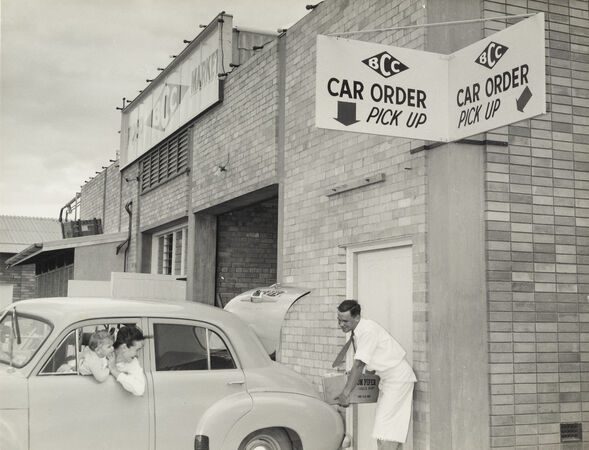
Archival photographs show seven checkout stations inside the BCC store. Historical images also record rows of shopping trolleys and a dedicated car-order pickup point where staff loaded groceries into customers’ vehicles.
Takeover and lasting legacy
Independent operations ended shortly after the second Chermside launch. Woolworths acquired BCC’s 32-store network in 1958.
Subsequent redevelopments over the following decades transformed the original complex into modern-day Westfield Chermside. The retail habits visible in Chermside during the 1950s — self-selected groceries, shopping trolleys, centralised checkouts and car-based suburban shopping — became familiar features of Australian retailing.
The Chermside development also became an early model for the car-oriented shopping centres that spread across Australia in the decades that followed.
Published 2-Oct-2026