




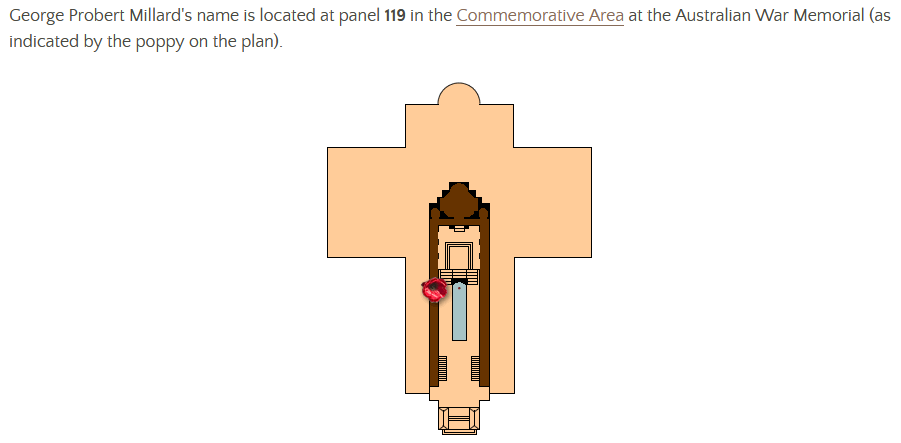
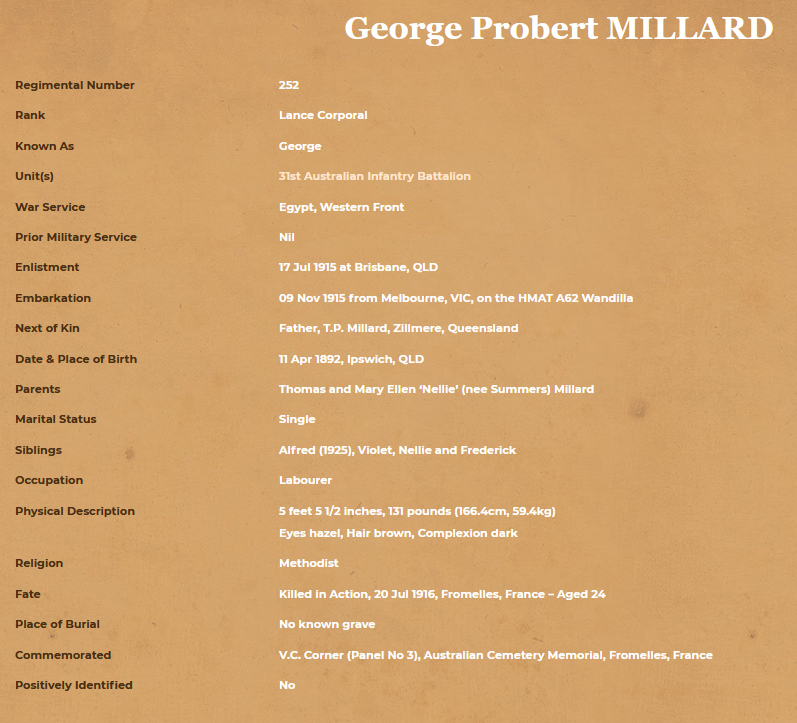
Lance Corporal George Probert Millard was one of many young men from across Queensland – Warwick, Maryborough, Brisbane, Cairns, Allora and Hughenden – who served with the 31st Battalion. He died, along with many others, during a single night of fighting on 19 July 1916 in Fromelle, France. Their names are known, but their final resting places are not. Now, only DNA can give George and his fellow soldiers back their names.
A Mass Grave and a World-first DNA Program
In 2008, a mass grave was uncovered behind German lines at Pheasant Wood, near the village of Fromelles. It contained the remains of 250 Australian soldiers. Since then, 180 have been formally identified and buried with named headstones – thanks to a world-leading program of DNA analysis and forensic research.
But 70 soldiers remain unknown. And the remains of George Probert Millard could be one of them.

A Local Hero Lost in the Chaos of War
George Probert Millard, a soldier in the 31st Battalion, was killed in action on 19 July 1916 during the Battle of Fromelles. This tragic battle, known for its heavy losses, saw Australian troops pushed into a brutal night of fighting near German lines. George, like many others, was buried in a mass grave at Pheasant Wood, a site where hundreds of Australian soldiers were later unearthed in 2008.
George’s father, a railway stationmaster, had worked in Zillmere after emigrating from the UK, making George’s story not just a distant tale of sacrifice but a piece of local history that needs to be remembered. Though George’s name is known, the exact location of his final resting place remains a mystery.

The Millard family received news after the battle that George was missing, but additional information came in piecemeal. A letter from W. Weston (likely William Weston, 11th Field Artillery Brigade, also from Zillmere) informed George’s father that his son had been wounded in the arm at Fromelles. However, Weston could not trace George in any English hospitals.

In September 1916, George’s father, Thomas, wrote to the Army requesting further details. By January 1917, Private Charles Jenkinson reported that George was thought to be a Prisoner of War. But a month later, Lieutenant Ivon Gair refuted this, noting there had been no German communication regarding George’s capture.
Despite these efforts, George was officially reported as ‘Killed in Action, 20 July 1916’ in a Court of Enquiry on 1 August 1917. There was also a note on his file stating that he had been ‘Buried in vicinity of Fleurbaix, Sh.36 N.W.’, but this was a very broad reference used for several soldiers, providing little clarity on his final resting place.
Now, his name is known, but his body remains one of the 70 still unidentified in the mass grave at Fromelles.


The Vital Role of DNA in Uncovering the Past
The Fromelles Association, a volunteer group working alongside the Australian Army, has helped identify many of those now named. They are now urgently searching for living relatives who may be able to donate DNA and help identify the “Final 70.”
Tony Ryan, a volunteer with the Fromelles Association of Australia, explains why this mission is so urgent.
“These men were sons, brothers, farmers, clerks; everyday Australians who gave their lives in France,” he said. “We know who they are. What we don’t know is exactly where they are. That’s where families can help.”
“Living memory is gone. Now we rely on family stories, photos, service records, and DNA,” he added.
The Association’s DNA testing program has already played a pivotal role in identifying soldiers who were previously unknown. But for the 70 still missing, every family story, photograph, or lead could be the one that cracks the case. “Every DNA match starts with a lead. One person, one photo, one family story—that’s all it takes,” Mr Ryan says.
The Association’s website enables the public to explore soldier stories, contribute memorabilia, and register as potential DNA donors. “They died for their country. The least we can do is name their graves,” Mr Ryan says. “No other group continues this level of forensic family research. We are their last chance.”
With the clock ticking, the Fromelles Association continues to work tirelessly alongside the Australian Army, hoping to give each of the final 70 soldiers a name and a proper resting place.
The urgency is real, as the window for identifying these men is closing, and with it, the chance to bring them home with the respect they deserve.
Call for DNA Donors: Help Identify George Millard
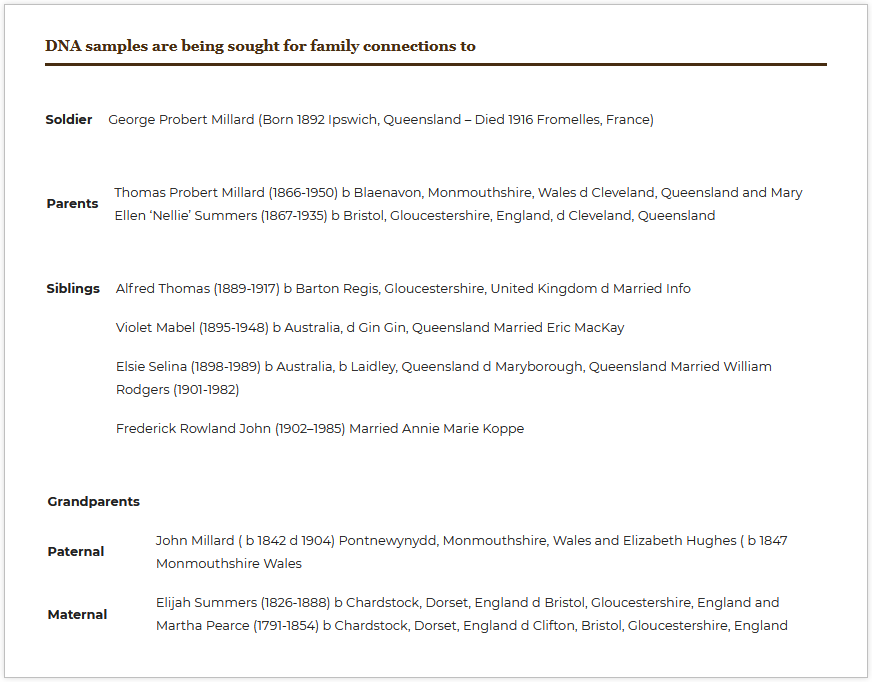
The search for George Probert Millard’s family is a critical part of the final phase of this project. The Fromelles Association is appealing to anyone who might have connections to George’s family. Whether you live in Queensland or Wales, or have information on the Millard family tree, the Association needs your help.
If you are a descendant of George Probert Millard or have any information that could help, please reach out to the Fromelles Association. Your contribution could be the one that finally uncovers his final resting place and brings closure to a century-old mystery.
Other Missing Heroes
Here are the other missing heroes from the 31st Battalion who remain unaccounted for and could be one of the unidentified bodies needing DNA for identification:
- Lieutenant Ernest William Spreadborough – 42, grazier from Warwick. The oldest officer of the 31st Battalion at Fromelles. Killed while leading his men during the assault.
- Private Thomas Henry Tedford – 20, from Maryborough. Enlisted with his brother Billie. Killed in action on 19 July 1916; his body was never found.
- Private John Charles Radford – 24, warehouseman from Brisbane. Wrote home just before the battle, describing being “in a warm corner and expecting a big attack.”
- Private Stanley Byfield King (alias King Smith) – 20, from Stanley, Queensland. He enlisted under the name “King Smith” while playing in the famous Toowoomba Brass Band. Along with the bandmaster and other members, he joined the 31st Battalion to form its brass band. His body was never recovered.
- Private George Olson Sutherland – 21, born in Scotland, lived in Queensland. Killed during the charge at Fromelles.
- Private Arthur Donald Leigh – 23, from Landsborough. One of several Queenslanders killed in the same assault wave.
- Private Walter Ernest Bain – 22, teamster born in Casino, joined from Queensland. Killed in the early stages of the attack.
- Private James Joseph Curran – 29, originally from Maitland, NSW, enlisted in Queensland. No known grave.
- Private Hector McDonald McLeod – 33, fencer from Apsley, Queensland. Killed on 19 July 1916 during the 31st Battalion’s attack. (Profile link currently unavailable)
Full stories and soldier profiles are available at www.fromelles.info.
About the Fromelles Association of Australia
The Fromelles Association is a volunteer-led organisation dedicated to identifying Australian soldiers who died in the Battle of Fromelles and were buried in mass graves. Through DNA testing, archival research, and forensic work, the Association helps to give these men back their names, providing families with closure and ensuring their sacrifices are honoured.
For more information or to register as a potential DNA donor, visit www.fromelles.info.